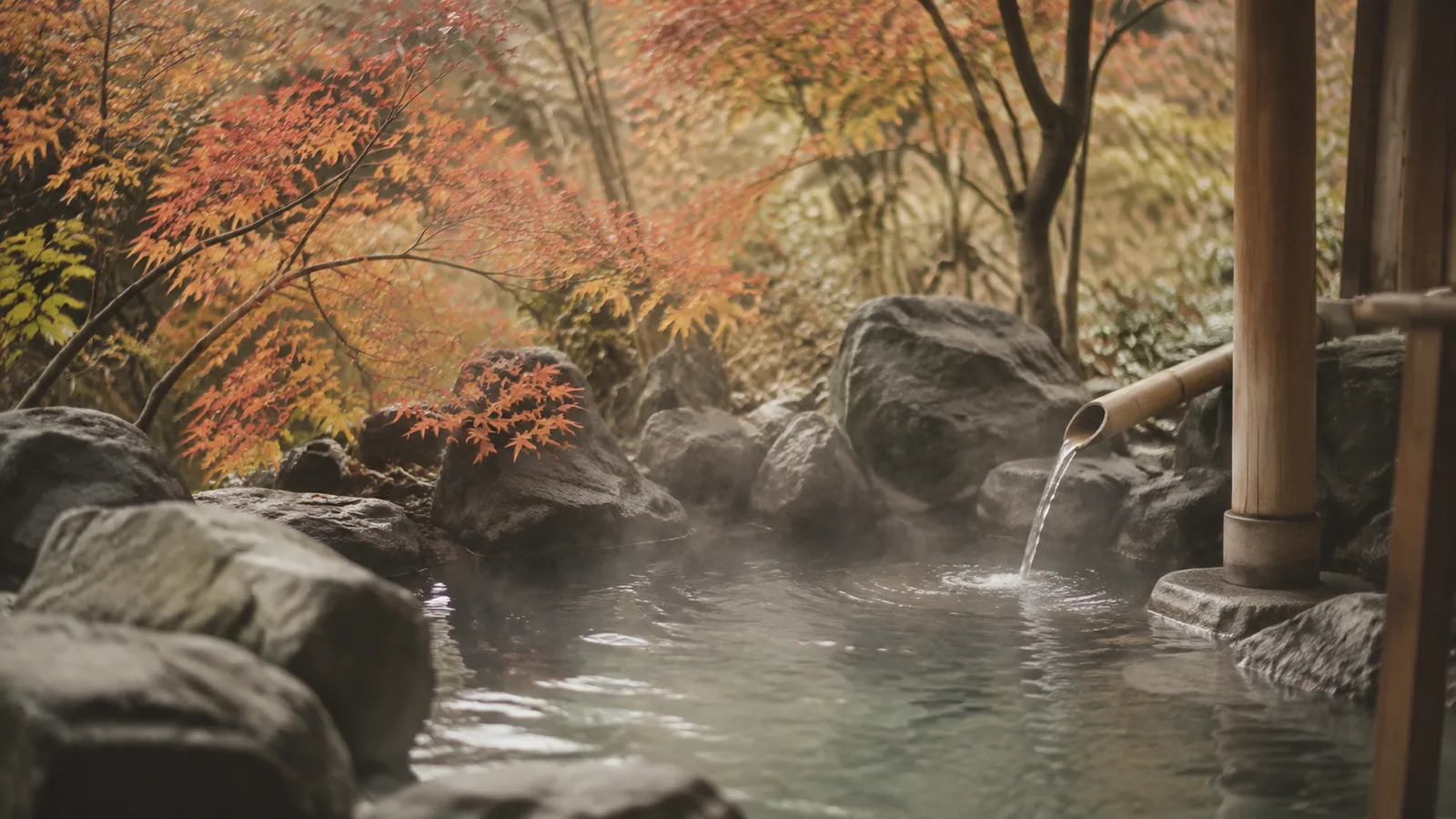
If you’ve looked at photos of Japanese hot springs, the ones that tend to stay with you are usually outdoors: a stone pool at the edge of a forest, steam lifting into cold air, a mountain somewhere in the background. That kind of bath has a name—rotenburo—and this guide walks through what it is, where you’ll find one, and how bathing outdoors differs from the indoor version.
The short answer
Rotenburo (露天風呂) means “open-air bath.” It’s a bath that sits partly or fully outdoors, so you soak with the sky overhead and, often, a view in front of you. An outdoor bath at an onsen or ryokan usually draws on the same natural hot-spring water as the indoor baths, though the source varies from one facility to the next. What sets a rotenburo apart is where it is: Japan’s tourism board points out that alongside springs known for their history or the make-up of their water, there are others where “the setting is just as much of a draw.” Some are rough rock pools in the mountains; others are carefully designed stone baths at a ryokan.
What makes bathing outdoors different
The appeal is mostly about air and view. Japan’s tourism board highlights an open-air bath set high enough in the mountains that you soak above the cloud line, and one that opens before dawn so bathers can watch the sun rise over the plain below. Many bathers especially seek them out in winter, when steam rises visibly off the surface in cold air and the contrast between the hot water and the cool air on your shoulders becomes part of the draw.
None of this changes what the bath is. It’s the same unhurried soak as the indoor version, in a nicer room, with the ceiling taken off.
Because the view is the point, timing matters more than it does indoors. Early morning and dusk tend to be quietest, and the light is better; a bath facing a garden or a valley looks completely different at those hours than at midday. Weather works both ways, too—fresh snow or autumn color can make a plain little bath memorable, while heavy rain or strong wind sometimes closes an exposed rotenburo entirely. If a specific outdoor bath is the reason you’re booking a place, it’s worth checking whether it stays open year-round.
Where you’ll find one
Rotenburo are common in hot-spring towns and at ryokan, and some hot-spring facilities closer to cities have them too. They’re rarely found in private homes. At a ryokan, an open-air bath might be a larger shared one, or a small bath attached to your room. Many ryokan also offer a private open-air bath you can reserve for yourself or your group (kashikiri), which Japan’s tourism board suggests as a comfortable option if bathing among strangers feels unfamiliar.
For how hot-spring towns are laid out and how to plan a first visit, see our guide to onsen towns in Japan. If a full trip isn’t on the calendar, onsen in Tokyo covers day-use options within reach of the city, some of which have open-air baths.
The etiquette is the same, with a few extras
An open-air bath runs on the same routine as any Japanese bath, so the indoor sequence carries over unchanged. A rotenburo mainly adds two things worth knowing.
The first is order of operations. The washing stations are indoors; the open-air bath rarely has any of its own. So you wash, rinse, and often soak indoors first, then walk out to the rotenburo already clean. That walk is usually a short, cool passage or a few stone steps, sometimes barefoot on wet ground, so it’s worth taking slowly.
The second is that the view doesn’t change the camera rule. Photography is forbidden throughout the bathing area, indoors and out, no matter how good the scene is.
Going straight from very hot water into cold outdoor air, especially in winter, is enough to make some bathers feel light-headed. Stand up slowly, pause before you cross between baths, and keep some drinking water within reach for when you feel too warm.
What about tattoos?
The tattoo question applies to a rotenburo exactly as it does to any onsen. An open-air bath is almost always part of a larger onsen or ryokan, so its tattoo policy is that facility’s policy. Policies vary from place to place, and while attitudes are slowly changing, some facilities still ask guests to cover tattoos or offer a private bath instead.
Confirm the facility's tattoo policy on its official website before you visit. A private or in-room open-air bath is one way around a strict policy.
For a fuller look at how tattoo policy breaks down and how to check before you go, see our guide to tattoos at a Japanese onsen.
If you want to try an open-air bath without planning a trip around one, there are a handful inside Tokyo. This is a guided session at a small open-air bath near the Skytree—you soak outdoors, with a wooden deck and the sky overhead, and there’s sake or ice cream afterwards. Worth knowing before you book: it’s a shared bath separated by gender, not a private one, and don’t count on the large open-air bath if you’re a woman: the listing says that since February 2024, because of chimney work, the large open-air bath has been men-only and the small open-air and carbonated baths women-only, with no switching by day (an older line on the same page still describes alternating days; checked September 28, 2026). It also accepts tattoos, which not every bath does.
See the open-air onsen in Tokyo on KlookThis page contains affiliate links. If you book through them, AHH, JAPAN may earn a commission at no extra cost to you.
A gentle first visit
If undressing outdoors sounds like a lot for a first time, start small: a bath attached to your guest room, or a reservable private one (kashikiri). Both give you the open sky and the view without an audience. A shared rotenburo is an easy next step once the indoor routine feels familiar—nothing about the sequence changes outdoors.
Two of our other guides pick up where this one stops. The beginner’s guide to Japanese baths walks through the indoor sequence step by step and sorts out sento, onsen, and super sento. And Home Onsen 101 is for the stretches between trips, when the nearest hot spring is your own tub.
Sky above, warm water below. Ahh…
Curious about YUGE, the character guiding you through this site? Meet YUGE—and find a few small ways to bring that calm home—on the YUGE page.
Some editorial images in this article were AI-generated and do not depict specific venues.
Sources
- Japan National Tourism Organization — A Bath with a View: Japan’s Most Amazing Outdoor Hot-Spring Baths
- Japan National Tourism Organization — How to Best Enjoy Japan’s Onsen
- Japan National Tourism Organization — Onsen Hot Springs: On Tattoos and Etiquette
- Klook — Tattoo-friendly open-air onsen experience in Tokyo (listing conditions)